
Tax on cryptocurrency mining in Poland: what you need to know
When income arises, how PIT-38 and the 19% tax work, what about electricity and hardware costs, and when to consult a tax adviser in Poland.
This article is a general overview of the rules, not tax advice. Regulations and interpretations change, and how they apply depends on your situation. If you mine on a larger scale, consult a tax adviser.
When you pay tax
Under Polish personal income tax (PIT), what is taxed is the disposal of virtual currency for consideration, i.e.:
- selling cryptocurrency for zloty or another traditional currency,
- paying with cryptocurrency for goods or services.
Exchanging one cryptocurrency for another (e.g. LTC for BTC) is not a taxable event. Neither is simply holding mined coins.
How much the tax is
Income from cryptocurrency (revenue minus costs) is taxed at a rate of 19%. You report it in the PIT-38 return by the end of April of the following year. Income from cryptocurrency is not combined with income from shares and other instruments: they are separate “baskets”.
Important: any excess of costs over revenue is carried forward to the next year. If in a given year you incurred costs (e.g. you bought a miner) but sold nothing, you report them in PIT-38 so that you can deduct them later.
What about costs: electricity and the miner
Deductible costs are documented expenses incurred directly to acquire virtual currency. With mining, the question is whether electricity, the purchase of a miner or hosting counts as the cost of “acquiring” the mined coins. In individual tax rulings, the tax authorities take different approaches to this issue, and the outcome depends on how the facts are described.
In practice it is worth:
- keeping all invoices: for the miner, electricity (ideally with a separate meter or sub-meter), hosting and parts,
- keeping records of mined coins: dates, amounts, pool payouts,
- on a larger scale, considering applying for an individual tax ruling or talking to an adviser.
Running a business
Large-scale mining is often done through a company, if only because of the electricity contract or buying hardware on a VAT invoice. However, the regulations provide special rules for income from virtual currencies, and the choice of legal form (sole proprietorship, company) matters a great deal for tax. This is definitely where it pays to get help from an adviser.
VAT
At EU level, cryptocurrency mining is usually treated as an activity outside the scope of VAT, and exchanging cryptocurrency for traditional currency as VAT-exempt (CJEU judgment in case C‑264/14 Hedqvist). For businesses, details such as deducting VAT on the purchase of a miner require analysis.
Summary
- You pay tax only when you sell for fiat or pay with cryptocurrency.
- The rate is 19%, and you file the return on PIT-38.
- Document everything, because it is the basis for deducting costs.
- On a larger scale, talk to an adviser or apply for a tax ruling.
This article is for information only and is not investment or tax advice. Links to the store and partners may be affiliate links.
Read more

Exchanges with a MiCA licence: where to legally sell mined crypto in 2026
Since 1 July 2026 only exchanges with a MiCA licence may operate in the EU. Which ones have it, what about Binance and Polish exchanges, how to check it.
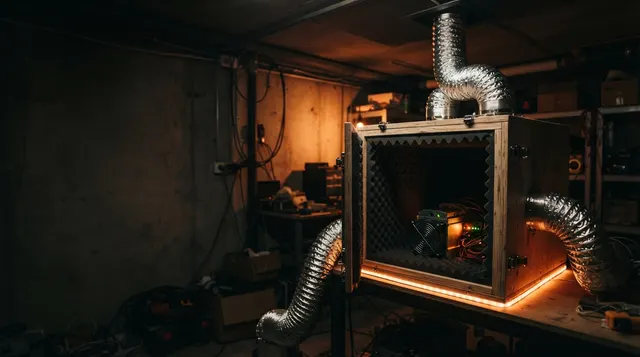
Noise and cooling: how to set up an ASIC miner at home
75 dB and 3.5 kW of heat: where to put an ASIC miner, how to quieten and cool it. Air cooling, water cooling and home mining models compared side by side.

How much electricity does an ASIC miner use and how do you calculate the cost?
A simple formula for a miner's power consumption and electricity cost, examples for the Antminer S21 XP, L9 and Avalon Nano, and what really drives up the bill.